If you serve on a homeowners’ association (HOA) or condo board, you’ve probably heard the buzz around electronic voting. Elections are one of the most important (and sometimes most stressful) responsibilities a board faces. Across the U.S., communities are required to hold board elections regularly, every four years at most, but often communities choose to elect new board members every one to two years. And, the truth is that, without the right process, they can quickly become time-consuming, confusing, and even contentious.

Back in 2024, the Florida Legislature passed Statutes Provision 720.317, allowing associations to adopt electronic voting if they meet certain conditions. Since then, updates and clarifications have made e-voting not only possible but increasingly attractive for boards that want to modernize, save time, and boost participation.
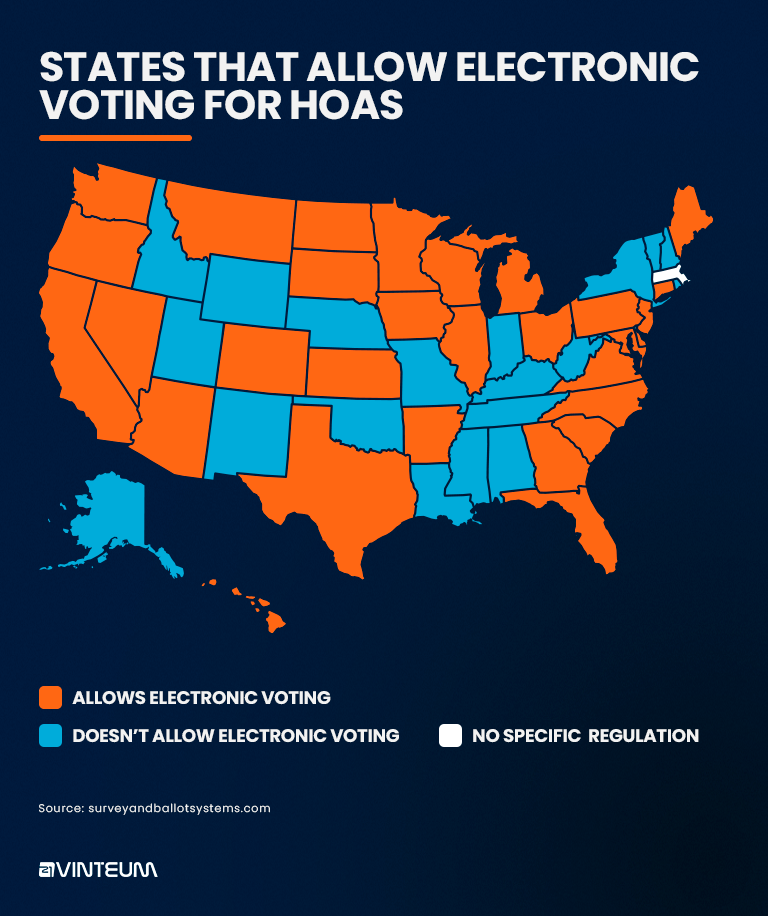
And Florida isn’t alone. E-voting is a growing trend among communities; other states across the U.S. have taken steps to authorize online voting for HOA and condo board elections, with more expected to follow. 30 of 50 states currently allow Electronic Voting in the US.
The result is confused board members, asking the same questions:
- How exactly does e-voting work?
- Is it really secure and legally valid?
- Does my state allow electronic voting for HOAs?
- What about privacy and transparency?
- Which platform should we use?
But don’t worry, keep calm and take a deep breath. In this article, we’ll break it all down: what e-voting is, how it works, the laws that make it possible, and how to implement it successfully in your community. We’ll also cover common pitfalls, share best practices, and show you how Neigbrs by Vinteum can help you run secure, compliant, and stress-free board elections.
Table of Contents
Understanding Electronic Voting
What is electronic voting?
Electronic voting (or e-voting) is the process of casting and counting votes using a digital platform instead of paper ballots or in-person voting. In an HOA or condo setting, it allows members to vote securely from their computers, tablets, or smartphones, thereby increasing voter participation.
How does e-voting for Board Elections work?
There are many ways to promote electronic voting in a community. The most modern HOAs and condo associations typically use a dedicated voting software that: authenticates each voter (verifies eligibility), presents ballots online, encrypts and stores votes securely, and counts and records results automatically. But, if you are not that familiar with technology and want to start easy, it is possible through email voting, sending ballots via email (it is often less secure and not always compliant).
Is Electronic Voting Secure?
Yes. When you use the right platform, electronic voting can be even more secure than traditional paper ballots. A compliant e-voting system combines safeguards like encryption to protect vote data, authentication to ensure only eligible members can vote, audit trails to verify the process without revealing individual choices, and role-based permissions so only authorized administrators can manage settings and results. Even if you’re not ready to implement full-scale e-voting software, incorporating technology — such as digital vote counting or secure registration tools — can still significantly reduce the human errors and security risks common with paper-based methods.
How does it differ from traditional voting?
While traditional paper-based voting has been the norm for decades, electronic voting offers clear advantages that can make elections smoother, more secure, and more inclusive. Electronic voting delivers results almost instantly once polls close, compared to the hours or even days required to manually count paper ballots. Digital storage eliminates the risk of lost or misplaced ballots, ensuring accurate record-keeping and easy auditing. It also allows members to vote from anywhere, increasing participation rates. Most importantly, a well-designed e-voting system uses encryption, authentication, and audit trails to safeguard results, providing a higher level of security and integrity than traditional methods could ever achieve.
Is electronic voting for HOAs and Condos allowed in my state?
It depends. Not all states allow electronic voting, so you need to be careful and check your state’s regulations before rolling out electronic voting. As mentioned, many states have adopted laws permitting e-voting, but in any case, the rules, procedures, and obligations differ. That’s why, again, always check your state statutes and your association’s governing documents before rolling out.
For you to start, check out the list of states below, whether they allow e-voting or not and the related laws/statutes.
| State | Is Electronic Voting permitted? | Related Law / Statutes |
|---|---|---|
| Alabama | No | 10A-3-2.05 |
| Alaska | No | AK Stat Sec 10.20.071 |
| Arizona | Yes | Arizona Stat 10-3708 |
| Arkansas | Yes | Arkansas Stat 10-3708 |
| California | Yes | Civil Code §§ 5105, 5110, 5115, 5120, 5125, 5200, 5260 (Amended by AB 2159) |
| Colorado | Yes | CO Code § 38-33.3-310 (2022) |
| Connecticut | Yes | CT Gen Stat § 47-252 (2022) |
| Delaware | Yes | Title 25, § 81-310 |
| Florida | Yes | Florida Stat. 720.317 |
| Georgia | Yes | O.C.G.A. § 14-3-708 |
| Hawaii | Yes | Section 514B-121, Hawaii Revised Statutes |
| Idaho | No | Sec 55-3204 |
| Illinois | Yes | 765 ILCS 160/1-25(i) |
| Indiana | No | IN Code § 32-25.5-3-10 (2022) |
| Iowa | Yes | IA Code § 504.708 (2022) |
| Kansas | Yes | KS Stat § 58-4614 (2021) |
| Kentucky | No | KY Stat 273.201 |
| Louisiana | No | RS 12: 1-728 |
| Maine | Yes | Title 13.B § 604 |
| Maryland | Yes | MD Real Property Code Ann. § 11B-113.2 (2022) |
| Massachusetts | No law distinctly allows nor prohibits | |
| Michigan | Yes | MI Comp § 450.2408 (2022) |
| Minnesota | Yes | MN Stat 515B.3-110 |
| Mississippi | No | MS Code § 79-11-211 (2020) |
| Missouri | No | MO Rev Stat § 355.266 (2022) |
| Montana | Yes | MT Code Title 35 § 2-533 (2021) |
| Nebraska | No | NE Code § 21-264 (2022) |
| Nevada | Yes | NV Rev Stat § 116.311 (2022) |
| New Hampshire | No | NH Rev Stat § 293-A: 7-28 (2022) |
| New Jersey | Yes | NJ Stat Sec 45: 22A-45.2 |
| New Mexico | No | NM Stat § 47-16-9 (2021 |
| New York | No* | NY Stat 6 § 613 |
| North Carolina | Yes | NC Stat 7 § 55A-7-01-40 |
| North Dakota | Yes | ND Cent. Code § 10-33-74 |
| Ohio | Yes | OH Rev Stat § 1702.20 |
| Oklahoma | No | OK Stat Title 18 § 1075.1 |
| Oregon | Yes | ORS § 94.661 |
| Pennsylvania | Yes | PA Stat 68 § 5310 |
| Rhode Island | No | RI Gen Laws § 7-6-20 |
| South Carolina | Yes | SC Code § 33-31-708 |
| South Dakota | Yes | SD Stat § 47-23-9 |
| Tennessee | No | Tenn Code § 48-57-205 |
| Texas | Yes | TX Code Title 2 § 22.160 |
| Utah | No | UT Code Title 16 § 6a-709 |
| Vermont | No | 11B V.S.A. § 7.08 |
| Virginia | Yes | VA Code § 55.1-1832 (2022) |
| Washington | Yes | RCW 24.03.085 |
| West Virginia | No | WV Code § 31E-7-724 |
| Wisconsin | Yes | WI Stat § 181.0708 |
| Wyoming | No | WY Stat § 17-19-708 |
In summary, the majority of the states already have a regulation allowing community associations to hold board elections through an electronic environment. See the graphic below.
The Problem with Traditional HOA Voting
If you’ve read this far, you may be wondering what the problem is with the traditional paper ballot vote. So before we get to the good stuff and the actual tips for online voting, let’s be honest about the pain points you’re probably facing with paper-based votes:
- Low turnout: requiring members to attend in person or submit mail-in ballots limits participation (which increases complaints), particularly for property owners who rent out their properties.
- Manual errors and corruption: hand-counting ballots can lead to mistakes due to human oversight, as well as the potential for corrupt practices to influence the results.
- Lost or late ballots: postal delays or misplaced papers cause voting losses, which can result in disputes in the future.
- Poor auditability: as mentioned, paper can facilitate corruption; similarly, proving vote integrity can be challenging without a paper trail or secure record.
If this sounds familiar, you’re not alone, and it’s exactly why many boards are making the switch.
The Benefits of Electronic Voting for HOAs and Condos
The e-voting comes with many benefits for associations, especially increasing resident participation and satisfaction throughout the process. Let’s explore some of them:
- Higher Participation Rates: Imagine that with an electronic voting process for board elections, homeowners can vote from anywhere, whether at home, work, or on vacation. This proves particularly useful in communities with many renters, where only owners are eligible to vote. The result is a more engaged community in important decisions.
- Time and Cost Savings: The digital environment can help you save significant time and money by eliminating the need for printing, postage, and manual counting.
- Transparency and Easy Auditing: Using a digital solution for board elections allows for secure storage of voting records in detailed logs.
- Legal Compliance: When done right, it can help your community meet state statutes and bylaw requirements.
- Immediate Results: The worst about any election is waiting for the results; in that sense, an electronic process allows you to announce winners right after polls close.
What Is an Online Voting Software for Condos and HOAs?
A virtual board election is not simply creating a generic online form or survey to get the new board president. It is essential to follow a series of parameters to guarantee that each vote is valid, corresponding to a unit and to ensure that a homeowner cannot vote twice, for example.
Whether your board chooses to adopt the electronic procedure through email or to hire a specialized HOA e-voting software, as Neigbrs by Vinteum, there are some key features you should consider as a requirement:
- Secure logins tied to member records — if your community chooses email voting, this can solely mean the residents’ personal email login and password, in a software.
- Role-based permissions for election management.
- Built-in compliance with state HOA laws.
- Automatic audit logs for transparency.
- Vote anonymity to protect privacy.
How Board Elections Work in Neigbrs
Our Board Election feature is designed to feel effortless for both board members and residents, while keeping every vote secure and compliant. Whether your community prefers the openness of a public tally or the privacy of a secret ballot, Neigbrs offers both options with clarity and confidence.
Here is how it works:
- Board Sets Up the Election
You define the election date, wheter it will be open or anonymous, candidates, and ballot questions in the platform. - Members Receive Credentials
Each unit represents one vote, the vote is secured by a token randomly generated. - Members Vote
Voting is done on any device; computer, tablet, or smartphone, after that the homeowener receive an email confirming the vote. - Votes Are Counted and Stored
Encryption ensures privacy, and results are stored securely for auditing.
What Are the Open and Anonymous Vote Modes?
In an Open Vote, every participant’s selections are visible to the community, fostering transparency and shared accountability, a great fit for matters where openness builds trust. In an Anonymous Vote, each voter receives a randomly generated token by email, allowing them to verify and audit their ballot without attaching their name to it. This approach keeps votes private while maintaining a fully auditable process to protect integrity.
To promote fairness, each unit or household can submit only one vote by default, and participation is limited to Primary Residents or, when they’re unavailable, Absentee Owners.
Besides that, because it’s built on the same intuitive framework as our Votings/Surveys module, the Board Election tool feels instantly familiar, with guided prompts, a clean design, and smooth integration that makes running an election less of a chore and more of a streamlined community event.

Is Voting by Proxy Possible with E-Voting?
In general, proxy voting means one member authorizes another to vote on their behalf. Some associations allow it, others don’t. However, with e-voting, proxy voting is possible if your platform supports it and your bylaws permit it. But attention, no matter the methods you choose, a vote by proxy often mandates assigning an offical attested document and ensuring the proxy’s vote is tracked.
Florida HOA Election Requirements
Before we go any further, it’s worth taking a moment to talk about something that often causes the most uncertainty during election season: state requirements.
While the general principles of electronic voting apply everywhere, each state sets its own rules for how HOA elections should be noticed, documented, and conducted.
And if your community is in Florida, those guidelines can feel especially detailed. But once you understand the basics, the process becomes much easier to navigate.
The Legal Framework Behind It
In Florida, HOA elections are primarily governed by Chapter 720 of the Florida Statutes, the Homeowners’ Association Act. Some associations may also refer to Chapter 617, which covers nonprofit organizations, and, of course, your own governing documents (such as bylaws and covenants).
Unlike condominium associations — which have very detailed election laws under Chapter 718 — HOAs in Florida are given more flexibility. That means your HOA’s rules and procedures matter just as much as the state laws.
Still, even without identical rules, many legal professionals recommend that HOAs mirror condominium-style election procedures to help prevent confusion and disputes.
Election Notices
For condominium associations, Florida law requires a two-step notice system:
- A first notice at least 60 days before the election.
- A second notice (with ballots included) between 14 and 34 days before the election.
While this exact timeline isn’t mandatory for HOAs, it’s considered best practice to follow it. Doing so helps ensure that homeowners have enough time to prepare, review candidate information, and feel included in the process.
Electronic Voting in Florida HOAs
If your board wants to introduce electronic voting, Florida Statute 720.317 outlines how to do it properly. The process is simple, but there are a few key steps to keep in mind:
1. Board Approval Comes First
Before launching online voting, your board must formally adopt a resolution that authorizes it. This resolution should outline how members will be notified, how they can give consent to vote electronically, and how they can opt out later if they prefer traditional voting.
2. Give Proper Notice
Members must be notified about the meeting where the electronic voting resolution will be discussed. This notice should be posted or delivered at least 14 days in advance, and proof of delivery (called an affidavit) must be kept as part of the association’s official records.
3. Member Consent Matters
Homeowners must opt in to electronic voting, either in writing or electronically. No one can be forced to vote online. And if a member changes their mind, they can opt out at any time.
4. Use a Secure System
The online voting platform you use must be able to:
- Verify each voter’s identity.
- Confirm each vote’s authenticity.
- Send a receipt after a vote is cast.
- Keep voter identities private (for secret ballots).
- Store votes securely for review if needed.
This is where solutions like Neigbrs’ Board Elections truly shines — offering an auditable, user-friendly platform that already meets these privacy and transparency standards.
Record Keeping and Compliance
Florida law also requires that HOAs keep detailed election records. According to Section 720.303(4), your association must maintain ballots, sign-in sheets, voting proxies, and all other voting-related documents for at least one year after an election.
Larger communities (with 100 or more parcels) must make certain official records available online or through a mobile app. In practice, many HOAs store these materials digitally for easier access and better organization — another area where digital tools like Neigbrs can help.
Resolving Election Disputes
If disagreements arise, for example, a challenge to the results or voting procedures, Florida law requires these cases to go through mandatory binding arbitration with the Division of Florida Condominiums, Timeshares, and Mobile Homes.
That might sound formal, but the goal is to resolve issues quickly and fairly without going straight to court.
Closing up
Navigating Florida’s HOA election rules doesn’t have to be stressful. Neigbrs’ Board Elections feature was built with these exact challenges in mind, giving your community a reliable, easy-to-use, and fully auditable way to handle the voting process.
Understanding these rules may feel like a lot at first, but they’re ultimately there to help your community run more transparent, fair, and legally defensible elections. This will reduce the likelihood of disputes and promote trust among community members.
With a clear process, effective communication, and the support of a secure digital platform, your community can navigate election season confidently and focus on what truly matters: choosing the leaders who will guide your HOA forward.
Best Practices for Implementing E-Voting in Your HOA
Before you step into the world of electronic voting, it’s important to prepare. To help your board ensure a smooth and compliant process, we’ve gathered a few best practices you should keep in mind. These tips will make your elections easier to manage and more transparent and reliable for your community.
- Start with legal compliance
Always review your state laws and your community’s governing documents before moving forward. Each state may have different requirements. For example, some states require sending homeowners a written notice at least 14 days before the election, while others mandate conducting a survey to confirm whether residents want the option of voting online. - Communicate clearly
Don’t rely on a single message. Send multiple reminders explaining how and when members can vote. Make sure the instructions are easy to follow, accessible, and shared through different channels (email, website, bulletin boards, etc.). Clear communication builds trust and ensures higher participation in the election. - Offer a test vote
A good idea is to give members the chance to practice with a mock ballot before the real election. This is especially helpful for those who may not feel tech-savvy. A simple test run helps residents get comfortable with the platform, reduces mistakes, and increases confidence in the actual voting process. - Provide support
Make sure members know help is available. Offer phone or email assistance for those who may struggle with technology. Having a support system in place ensures everyone feels included and able to participate. - Keep thorough records
Always save copies of election notices, ballots, results, and participation reports. Having accurate records on hand allows the board to attest to the process if questions arise and protects the community from disputes. Proper documentation is key to ensuring transparency and trust in your elections.
Plus: Common Pitfalls to Avoid
- Not updating governing documents: without bylaw amendments, your election could be invalid.
- Poor communication: if members don’t know where, when and how to vote, turnout will drop.
- Choosing the wrong Tool: generic survey tools may not meet legal or security requirements.
Final Thoughts
Electronic voting isn’t just a tech upgrade; it’s a way to make your HOA or condo board elections more accessible, secure, and transparent. And boards resistant to it will be left behind. Switching to electronic board elections brings many benefits for associations, but overall:
- Save time and money.
- Increase participation.
- Reduce disputes and challenges.
If you want to give that first step, discover our Board Election feature, which allows open and anonymous voting, inspired by the Florida Electronic Voting statute. Plus, with a platform like Neigbrs by Vinteum, you get more than just a voting tool. You get a fully integrated community management solution, from announcements and document sharing to resident engagement, with secure, compliant elections built in.
Ready to run stress-free, compliant board elections? Schedule a free demo of Neigbrs and see how our in-app Board Election feature works.